


‘The Dark Man: Journal of Robert E. Howard and Pulp Studies’ is a peer-reviewed scholarly journal devoted to the academic study of Robert E. Howard’s literary legacy as well as the literary historical and print culture contexts associated with it. The journal seeks to publish full-length articles, brief critical notes and commentaries, bibliographies, reviews of books, and other scholarship that treats Howard’s life, time, literary work, and associated topics such as Weird Tales, H.P. Lovecraft, and the concept of a transhistorical pulp fiction aesthetic.
Search Results for: dark valley
20
Mar
Mar
Edited by Mark Hall. The Dark Man V6N1 & 2.
The Dark Man: Journal of Robert E. Howard and Pulp Studies is a peer-reviewed scholarly journal devoted to the academic study of Robert E. Howard’s literary legacy as well as the literary historical and print culture contexts associated with it. The journal seeks to publish full-length articles, brief critical notes and commentaries, bibliographies, reviews of books, and other scholarship that treats Howard’s life, time, literary work, and associated topics such as Weird Tales, H.P. Lovecraft, and the concept of a transhistorical pulp fiction aesthetic.
11
Oct
Oct
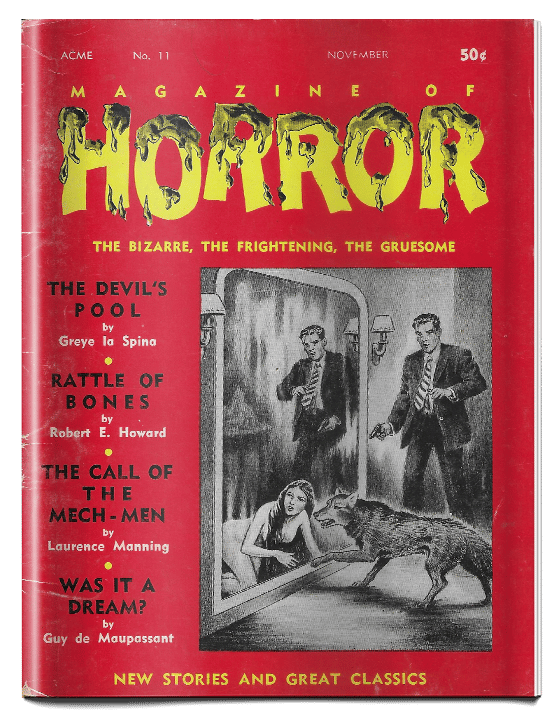
Magazine of Horror #11 (volume 2 number 5).
Contains RATTLE OF BONES, a Solomon Kane story, and the poem “The Dweller in Dark Valley”.

05
Jul
Jul
The Miscast Barbarian: a Biography of Robert E. Howard is a biography by science-fiction writer L. Sprague de Camp, first published in hardcover and trade paperback in 1975 by Gerry de la Ree.
The book is an expansion of de Camp’s article “The Miscast Barbarian”, which appeared in the magazine Fantastic in June, 1971. Later, in collaboration with Catherine Crook de Camp and Jane Whittington Griffin, he expanded the text again, into Dark Valley Destiny: the Life of Robert E. Howard (1983), the first major independent biography of Howard.

13
Dec
Dec
Fanciful Tales of Time and Space contained a mixture of weird, science fiction and fantasy stories, including work by August Derleth, David H Keller and H P Lovecraft, as well as the first publication of Robert E Howard’s poem “Solomon Kane’s Homecoming”.

06
Mar
Mar
Robert E. Howard was known for his affection for animals. At the time of his passing, 13 stray cats frequented his residence. However, one animal held a special place in his heart: his beloved dog, Patch. Patch served as a source of inspiration and fond memories for many of Robert’s stories later in life, and they were inseparable companions for over a dozen years. In an article by Ståle Gismervik, we learn more about Patch, and his bond with Robert. Read on to discover more about this extraordinary canine companion.

19
Feb
Feb
An article written by Rick Lai about the Legend of El Borak. Best known for his tales of heroic fantasy, Robert E. Howard (1906-36) also wrote contemporary tales of adventure for the pulps. Howard was influenced by Talbot Mundy, a major writer for Adventure in the 1920’s. Mundy’s heroes were American and British adventurers roving around India and the Middle East. Utilizing Mundy’s settings, Howard fashioned his own band of protagonists. Among Howard’s soldiers of fortune, the most famous is Francis Xavier Gordon.

21
Oct
Oct
Robert E. Howard wrote poetry. He wrote it first in life, last in life, and throughout life. Howard completed around 300 stories for commercial sale and worked on 300 more. But he wrote over 700 poems, virtually none of them meant for commercial markets. His first publication outside of school was his poem “The Sea”, published in a local paper. His famous “All fled, all done…” couplet, borrowed from Viola Garvin, was allegedly the last words he typed. And in between, poetry gushed from him.
This second volume of a three-volume set collects the rest of all of Howard’s known poetry.

26
Apr
Apr
We know that it was Lyndsey Tyson’s gun. Lyndsey told the lawyer that Robert had used his gun and he didn’t want anything to do with any of it. He was quite upset. Decades later, when talking to Glenn Lord, Lyndsey told him that was the dumbest thing he ever did. He should have taken those rights when he had the chance, maybe he could have gotten rich.

02
Jan
Jan
Winds of time is a beautiful book collecting many of Howards poems. Many translated into Polish and German. Interior art by Hubert Schweizer. Published by Thomas Kovacs and edited by him and Bernd Karwath.