A biography of Robert E. Howard by Rusty Burke. Introduction by Roy Thomas.
This is a great compendium of Howard’s fiction and poetry. These adventures, set in medieval-era Europe and the Near East, are among the most gripping Howard ever wrote, full of pageantry, romance, and battle scenes worthy of Tolstoy himself. Most of all, they feature some of Howard’s most unusual and memorable characters, including Cormac Fitzgeoffrey, a half-Irish, half-Norman man of war who follows Richard the Lion-hearted to twelfth-century Palestine—or, as it was known to the Crusaders, Outremer; Diego de Guzman, a Spaniard who visits Cairo in the guise of a Muslim on a mission of revenge; and the legendary sword woman Dark Agnès, who, faced with an arranged marriage to a brutal husband in sixteenth-century France, cuts the ceremony short with a dagger thrust and flees to forge a new identity on the battlefield.
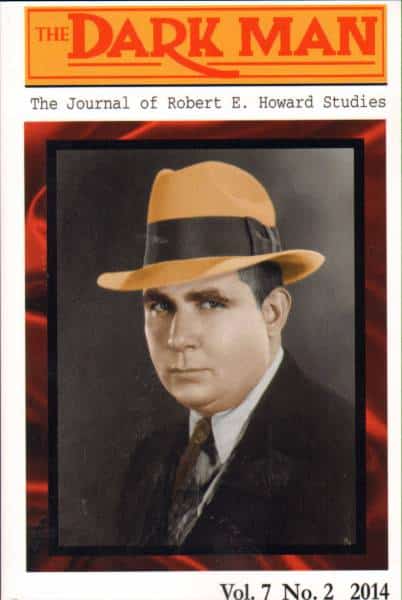
Edited by Mark Hall. The Dark Man V7N2.
The Dark Man: Journal of Robert E. Howard and Pulp Studies is a peer-reviewed scholarly journal devoted to the academic study of Robert E. Howard’s literary legacy as well as the literary historical and print culture contexts associated with it. The journal seeks to publish full-length articles, brief critical notes and commentaries, bibliographies, reviews of books, and other scholarship that treats Howard’s life, time, literary work, and associated topics such as Weird Tales, H.P. Lovecraft, and the concept of a transhistorical pulp fiction aesthetic.
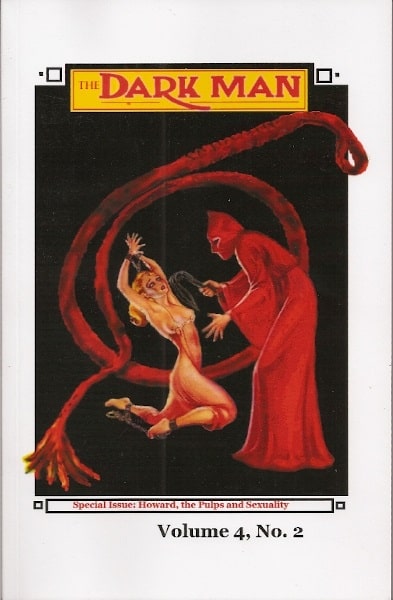
Edited by Mark Hall. The Dark Man V4N2.
The Dark Man: Journal of Robert E. Howard and Pulp Studies is a peer-reviewed scholarly journal devoted to the academic study of Robert E. Howard’s literary legacy as well as the literary historical and print culture contexts associated with it. The journal seeks to publish full-length articles, brief critical notes and commentaries, bibliographies, reviews of books, and other scholarship that treats Howard’s life, time, literary work, and associated topics such as Weird Tales, H.P. Lovecraft, and the concept of a transhistorical pulp fiction aesthetic.
Edited by Mark Hall. The Dark Man V2N1/2.
The Dark Man: Journal of Robert E. Howard and Pulp Studies is a peer-reviewed scholarly journal devoted to the academic study of Robert E. Howard’s literary legacy as well as the literary historical and print culture contexts associated with it. The journal seeks to publish full-length articles, brief critical notes and commentaries, bibliographies, reviews of books, and other scholarship that treats Howard’s life, time, literary work, and associated topics such as Weird Tales, H.P. Lovecraft, and the concept of a transhistorical pulp fiction aesthetic.
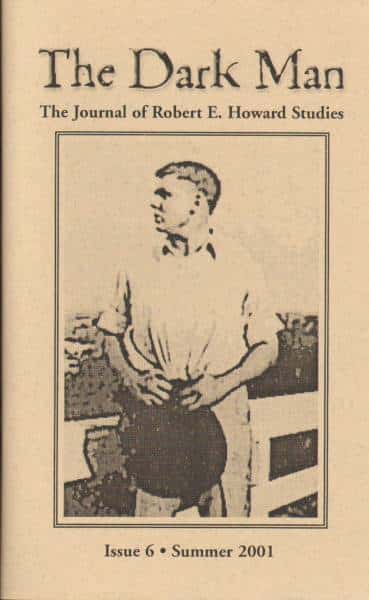
A chapbook from 2001. Edited by Frank Coffman.
The Dark Man: Journal of Robert E. Howard and Pulp Studies is a peer-reviewed scholarly journal devoted to the academic study of Robert E. Howard’s literary legacy as well as the literary historical and print culture contexts associated with it. The journal seeks to publish full-length articles, brief critical notes and commentaries, bibliographies, reviews of books, and other scholarship that treats Howard’s life, time, literary work, and associated topics such as Weird Tales, H.P. Lovecraft, and the concept of a transhistorical pulp fiction aesthetic.
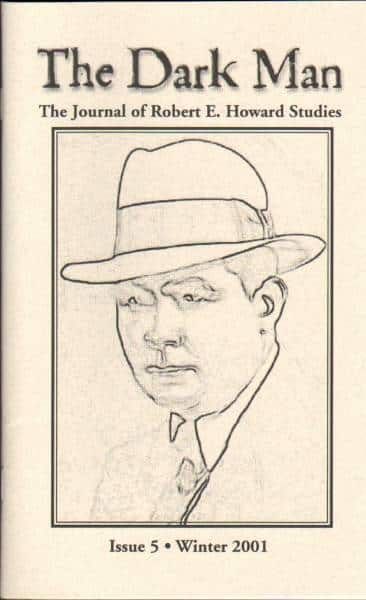
A chapbook from 2001. Edited by Frank Coffman.
The Dark Man: Journal of Robert E. Howard and Pulp Studies is a peer-reviewed scholarly journal devoted to the academic study of Robert E. Howard’s literary legacy as well as the literary historical and print culture contexts associated with it. The journal seeks to publish full-length articles, brief critical notes and commentaries, bibliographies, reviews of books, and other scholarship that treats Howard’s life, time, literary work, and associated topics such as Weird Tales, H.P. Lovecraft, and the concept of a transhistorical pulp fiction aesthetic.
The Man-Eaters of Zamboula. Typescript. Part 1 of 2.
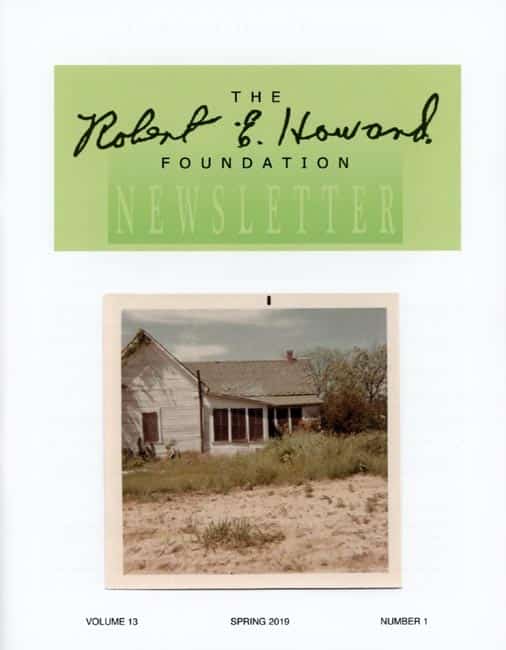
Cover is a photo of the Howard House in the late 1960s or early 1970s, before it was acquired and repaired by Project Pride.
Howard stories and poems, except of “What I Did in Vacation”, are facsimiles of typescripts. “What I Did in Vacation” is a facsimile of a hand-written school report.
Cover is a photo of Leroy and Faustine Butler with REH.
Contains an interview with Novalyne Price Ellis by Rusty Burke.
“Day of the Stranger” is a play.
“Speech about Robert E. Howard” was presented at the 1988 World Science Fiction Convention in New Orleans.