Intrigue in Kurdistan
Introduction
Intrigue in Kurdistan is an unfinished El Borak story centered on Frank Gordon amid political and tribal conflict in Kurdistan. It was not published during Howard’s lifetime. The surviving narrative breaks off before the role of a European woman and the larger political situation are fully resolved.
Summary spoilers
The story begins in a confrontational setting where Frank Gordon, an American known as El Borak, is held captive by Turkish authorities. His captor, a Turkish official named Kemul Bey, inquires about Gordon's incendiary activities among the Kurdish tribes, aiming to unite them against Turkish rule. A Kurdish informant has betrayed Gordon, hoping for a reward.
Gordon admits his intentions without resistance, revealing his disdain for Turkish atrocities in various regions and his desire to see Turkey's power diminished. Despite his capture, he remains defiant, hinting at his influence over regional tribes and his past military ventures that spread from Afghanistan to Kurdistan.
Gordon's escape from custody is marked by cunning and brutality. He overpowers guards using minimal force and improvises weapons from his surroundings. His familiarity with the castle's ancient, complex architecture aids his stealthy movements through hidden passageways and secret staircases.
Throughout his escape, Gordon encounters various figures, including Turkish soldiers and Kurdish prisoners, further highlighting the tension between different ethnic groups and the occupying Turkish forces. His ultimate goal is revealed to be a strategic destabilization of Turkey by inciting Kurdish rebellion, hoping to draw Turkish forces away from Europe and weaken their geopolitical standing.
The narrative also introduces a mysterious European woman imprisoned in the castle, adding a layer of intrigue and hinting at broader political entanglements involving Western interests in the region.
Textual states
Shown in a practical developmental order where possible: synopsis/outline, numbered drafts, submission states, then published or posthumous states. This display order does not itself assert exact chronology or textual authority.
Characters in this Work
Counts are across exact Textual Versions currently represented. Additional textual research may add further appearances.
Publication appearances
 El Borak l' É ternel (El Borak the Eternal)NeOMay 1984↗
 Pulse Pounding Adventure Stories #1Cryptic PublicationsDecember 1986↗
 E l Borak l' É ternel (El Borak the Eternal)Fleuve NoirJune 1992↗
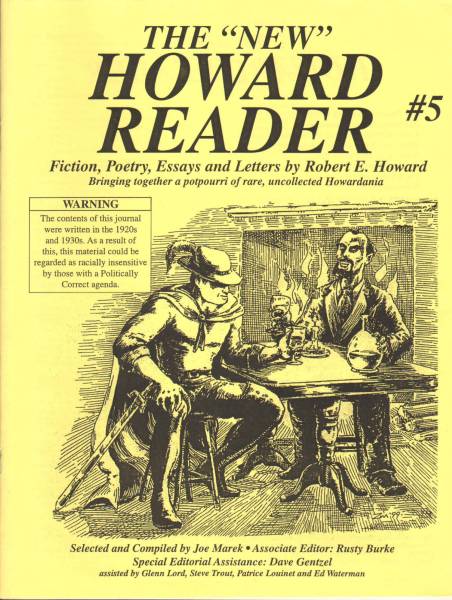 The "New" Howard Reader #5Joe & Mona MarekMarch 1999↗
 Barsoom número 5La Hermandad del Enmascarado (Spain)Spring 2008↗
 La llegada de El Borak y otras aventuras inéditas de Francis Xavier Gordon (The Coming of El Borak and Other Unprecedented Adventures of Francis Xavier Gordon)La Hermandad del Enmascarado (Spain)2010↗
 The Early Adventures of El BorakREH Foundation PressMarch 2010↗
 Малое собрание сочинений. Книга первая (Maloe sobranie sochinenii. Kniga pervaia) (Small Collected Works. Book One) Cover and publication information courtesy of the Russian website Laboratory of Fantasy .Independently Published2014↗
 По мотивам Роберта И. Говарда IV (Po motivam Robert I. Govard IV) (Based on Robert E. Howard IV) Cover and p ublication information courtesy of the Russian website Laboratory of Fantasy .Independently Published2018↗
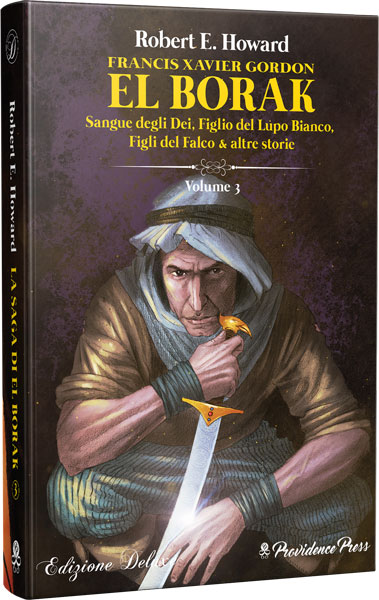 Francis Xavier Gordon, El Borak Volume 3Providence PressMarch 2023↗
 The Early Adventures of El BorakREH Foundation PressSeptember 2024↗
 La maldición de la daga de tres filos. Las aventuras de El Borak. Tomo 2 (Three-Bladed Doom - The Adventures of El Borak Book 2)La Hermandad del Enmascarado (Spain)April 2025↗