The Black Moon
Introduction
"The Black Moon" is a captivating detective story by Robert E. Howard, featuring the character Steve Harrison, a tough and savvy detective. The narrative is steeped in an exotic setting that blends mystery with a touch of the supernatural, typical of Howard's ability to intertwine the gritty realism of detective fiction with elements of the fantastical.
Howard's agent, Kline, received the story on September 12, 1933.
Summary spoilers
The story begins in an antique shop owned by Wang Yun, where he shares with Steve Harrison the legend of the White Fox Spirit. Wang Yun is in the middle of feeding his pet cobra, Pan Chau, when he receives a mysterious phone call instructing him to stay by the machine until someone arrives. However, no one comes, and after hearing someone enter and quickly leave the shop, Wang finds nothing stolen but soon suffers a fatal cobra bite.
Steve Harrison, upon witnessing the incident, is skeptical of the circumstances, particularly noting that the cobra that bit Wang does not appear to be his usual pet, Pan Chau, but a younger, more vibrant snake. Harrison begins to investigate, suspecting foul play and a deeper mystery involving other characters connected to the story.
His investigation leads him to William D. Feodor, a scientist who had lost a cobra and was conducting experiments on snake venom. Feodor reveals that his cobra was stolen, and details emerge that suggest a link between his missing snake and the one that killed Wang Yun.
Harrison discovers that the motive behind the murder was a rare black pearl, known as The Black Moon, hidden inside one of Wang Yun's antiques. The detective sets a trap to catch the killer, using the pearl as bait. In a dramatic conclusion, Harrison catches Feodor red-handed, disguised as a Chinaman, attempting to steal the pearl. The story ends with the revelation that Feodor was color blind, which led to a crucial oversight in his plan.
Textual states
Shown in a practical developmental order where possible: synopsis/outline, numbered drafts, submission states, then published or posthumous states. This display order does not itself assert exact chronology or textual authority.
Characters in this Work
Counts are across exact Textual Versions currently represented. Additional textual research may add further appearances.
Publication appearances
 Bran Mak Morn: A Play and OthersCryptic Publications1983↗
 Steve Harrison et le Talon d'argent (Steve Harrison and the Silver Heel)NeOMarch 1985↗
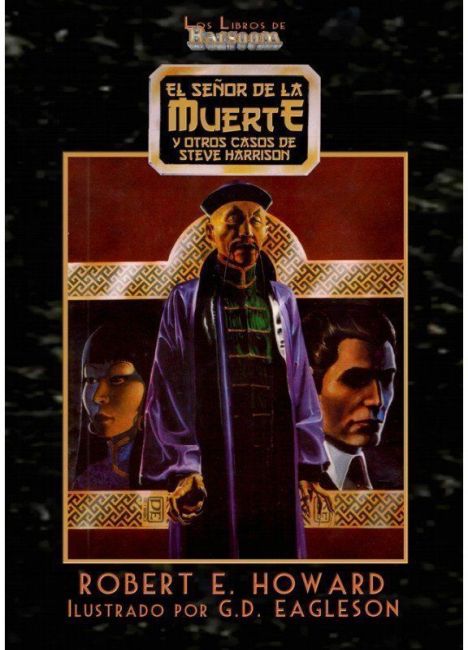 El señor de la muerte y otros casos de Steve Harrison (Lord of the Dead and Other Cases of Steve Harrison)La Hermandad del Enmascarado (Spain)December 2008↗
 REH: Two-Gun Raconteur #13The Black Coast PressFall 2009↗
 Steve Harrison's CasebookREH Foundation PressJanuary 2011↗
 Малое собрание сочинений. Книга четвёртая (Maloe sobranie sochinenii. Kniga chetvertaia) (Small Collected Works. Book Four) Cover and publication information courtesy of the Russian website Laboratory of Fantasy .Independently Published2017↗
 Tutte le Indagini di Steve HarrisonElaraSeptember 2020↗
 Steve Harrison. Detective del Macabro, Le Nuove IndaginiProvidence PressOctober 2020↗
 Steve Harrison's Casebook - ultimate editionREH Foundation PressJune 14, 2022 (2.1 February 2026)↗