The Last Man
Introduction
The Last Man is an early speculative story that Howard described to Tevis Clyde Smith in a letter dated August 4, 1923. Set in a future shaped by prolonged war and changing global power, it was never published during Howard’s lifetime.
Summary spoilers
Chapter 1: War
The story begins in the year 2000, presenting a world ravaged by war, with the narrator reflecting on the history that led to this tumultuous state. The peace following World War I in 1918 lasted until 1960, with minor conflicts occurring between nations like Italy and Greece. The Soviet Union stabilizes and gains recognition, while the rest of the world focuses on technological advancements and economic competition.
The tranquility breaks when the U.S. and Japan go to war over the Philippines, leading to a series of conflicts involving various global powers, including a notable war between the U.S. and Britain in 1966. Technological advancements such as massive planes and advanced warfare strategies define these conflicts.
By 1980, the narrative describes a stagnant war between France and Russia, complicated by alliances and uprisings throughout Europe and Asia. This period also sees a rise in power from the Eastern world, particularly in the form of a unified and militarized Africa.
Chapter 2: The Last Man
In Richmond, the narrator encounters a white man demonstrating unusual physical prowess by defending himself against aggressive individuals. This man is revealed to be Frank Slade, who shares his concerns about the growing power of Africa and its potential threat to global stability. Slade elaborates on the demographic and military growth in Africa, driven by unity and preparation for an uprising against the white-dominated world order.
Slade predicts a major conflict initiated by Africa, aiming to overturn the existing racial hierarchies and establish black supremacy. This conversation is interrupted by news of native uprisings in South Africa, signaling the beginning of the envisioned conflict.
Chapter 3: Global Rebellion
The narrative fast-forwards to detail the massive and well-coordinated uprising across Africa and parts of Asia, resulting in significant losses for European powers. Slade, the narrator, and a Sikh named Chandra Singh witness the overwhelming defeat of British forces by the African army, showcasing superior physical prowess and strategic execution.
The black forces, led by charismatic and ruthless leaders, aim to not only conquer but also to subjugate the white populations, reversing the roles of colonizer and colonized. The chapter concludes with Slade and his companions narrowly escaping a deadly encounter with a powerful African chief, underscoring the imminent danger of the uprising and the uncertain future of the white race.
Textual states
Shown in a practical developmental order where possible: synopsis/outline, numbered drafts, submission states, then published or posthumous states. This display order does not itself assert exact chronology or textual authority.
Characters in this Work
Counts are across exact Textual Versions currently represented. Additional textual research may add further appearances.
Publication appearances
 The Last of the Trunk Och Brev i UrvalParadox Entertainment Inc.September 2007↗
 The Last of the TrunkREH Foundation PressNovember 2007↗
 Adventures in Science FantasyREH Foundation PressMay 2012↗
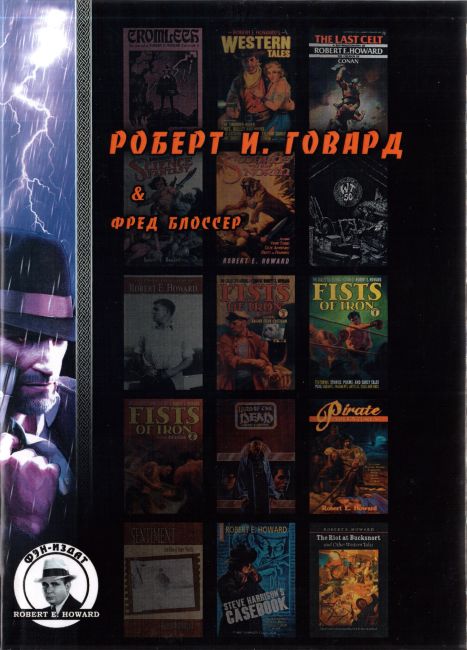 Малое собрание сочинений. Книга четвёртая (Maloe sobranie sochinenii. Kniga chetvertaia) (Small Collected Works. Book Four) Cover and publication information courtesy of the Russian website Laboratory of Fantasy .Independently Published2017↗
 Adventures in Science Fantasy - Ultimate EditionREH Foundation PressJanuary 31, 2025↗
 Almuric y otras historias de ci-fi (Almuric and Other Sci-Fi Stories)La Hermandad del Enmascarado (Spain)March 2025↗