Man
Introduction
Man is a complete prose piece of about 1,100 words, structured as a dialogue among a series of voices offering sharply different views of humanity, belief, existence and man's origins.
Summary spoilers
The story unfolds as a series of monologues delivered by various archetypal figures, each representing a facet of humanity’s struggle to define itself and understand its place in the universe.
The Scientist opens the discussion with a sweeping portrayal of man as the result of eons of evolutionary progress, rising from the "slime of the Paleozoic beaches" to his current form. However, he undercuts humanity's significance, describing it as nothing more than an insect or larvae compared to the grandeur of the cosmos. The Scientist rejects any concept of a soul or divine spark, declaring that life itself is the substance of existence, with individual lives being brief and insignificant in the grand scope of the universe.
The Minister presents a starkly different viewpoint, insisting that man possesses an immortal soul and must seize the opportunity to be saved. His rhetoric is passionate and direct, warning that time is running out to align with religion and achieve eternal salvation. The Minister's voice embodies traditional religious authority, offering hope while emphasizing fear of divine judgment.
The Woman serves as an observer who shifts focus between the various speakers, providing commentary that highlights society's shallowness and preoccupation with appearances. She admires the Minister for his earnestness and the Evangelist for his physical presence but dismisses the Scientist as a foolish old man lost in books. The Woman represents the contradictions and trivial distractions of everyday life, caught between idealism and self-interest.
The Evangelist delivers a fiery, confrontational speech, accusing the audience of cowardice, sin, and moral weakness. His words are laced with patriotic fervor and condemnation, invoking the sacrifice of fallen soldiers and mocking societal trends like short skirts and modern flappers. The Evangelist casts himself as a "red-blooded, two-fisted he-man" and positions himself as a dynamic, aggressive leader in the cause of religion.
The Idealist envisions man’s potential for perfection and progress. He speaks of humanity’s destiny as a climb toward enlightenment, where war, hunger, and hatred will be eradicated. Despite his lofty ideals and tireless efforts, he acknowledges that he may die unknown and unappreciated.
The Mystic counters the Idealist with a philosophy of self-denial and meditation. He rejects the physical world as an illusion, seeking peace through the annihilation of desire and individual identity. He speaks of Nirvana as the ultimate state, where life dissolves into an eternal, tranquil sea.
The Elemental Man bursts forth with primal energy, rejecting all notions of religion, idealism, and civilization. He declares himself a product of the ancient, untamed forces of life. Driven by hunger, lust, and violence, he embodies the basest instincts of humanity, reveling in destruction and bloodshed. He mocks the other voices, promising to rend and consume everything they hold dear—be it ideals, gods, or morality.
The Woman interjects again, trivializing the speeches and returning to concerns about social appearances and material pleasures. She dismisses the struggles of the working class and downplays societal issues, reflecting ignorance and detachment.
The Scientist concludes by reaffirming his view of man as an evolutionary product destined to reproduce, die, and return to the elements. He denies the existence of the soul and emphasizes that humanity’s journey is one of relentless physical processes, devoid of divine meaning.
The Minister reappears in the final moments, repeating his plea for salvation, reaffirming the presence of an immortal soul, and urging humanity to seek redemption before it is too late.
Textual states
Shown in a practical developmental order where possible: synopsis/outline, numbered drafts, submission states, then published or posthumous states. This display order does not itself assert exact chronology or textual authority.
Characters in this Work
Counts are across exact Textual Versions currently represented. Additional textual research may add further appearances.
Publication appearances
 The Last of the Trunk Och Brev i UrvalParadox Entertainment Inc.September 2007↗
 The Last of the TrunkREH Foundation PressNovember 2007↗
 Sentiment: An Olio of Rarer WorksREH Foundation PressDecember 2009↗
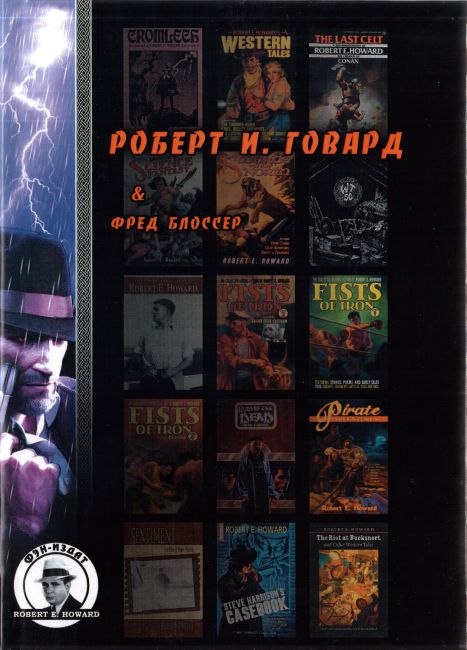 Малое собрание сочинений. Книга четвёртая (Maloe sobranie sochinenii. Kniga chetvertaia) (Small Collected Works. Book Four) Cover and publication information courtesy of the Russian website Laboratory of Fantasy .Independently Published2017↗