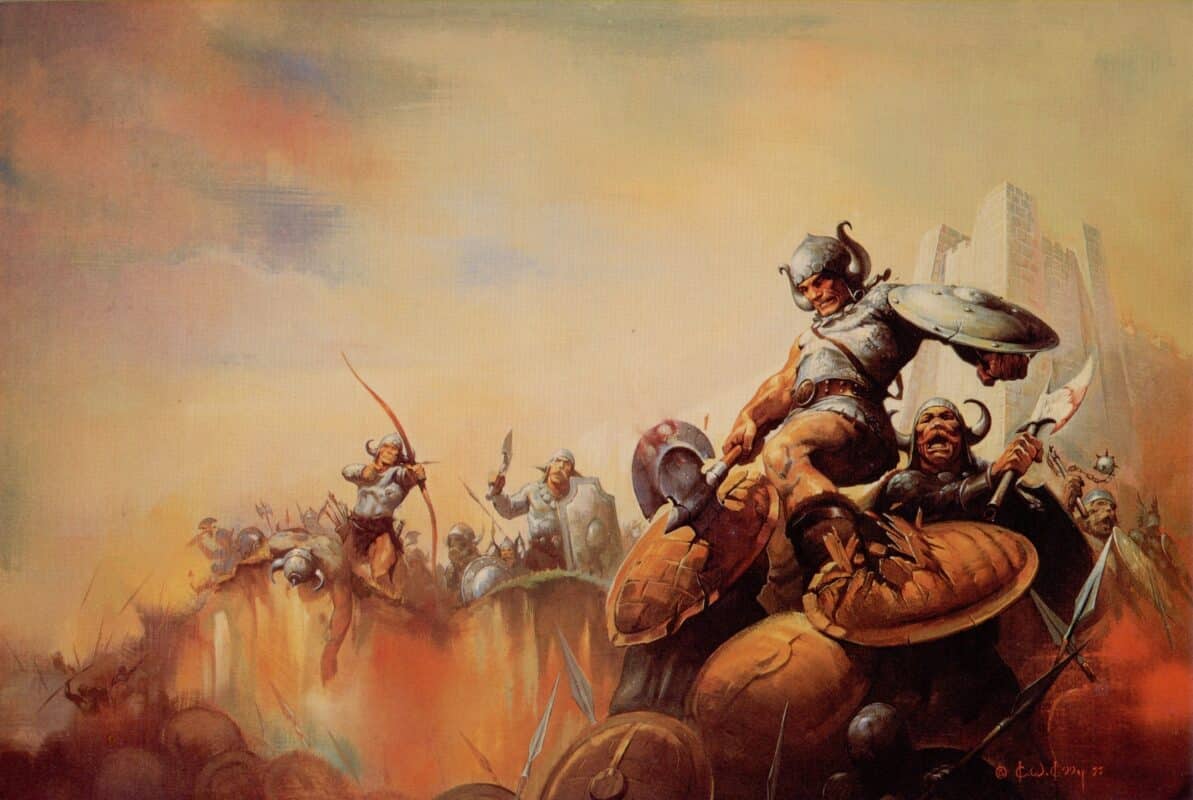
“The Phoenix on the Sword” is one of the original short stories about Conan the Cimmerian was written by Howard and first published in Weird Tales magazine in December 1932. The tale, in which Howard created the character of Conan, was a rewrite of the unpublished Kull story “By This Axe I Rule!”, with long passages being identical.
Search Results for: black god
The story begins with John O’Brien, the narrator, entering a dark, eerie forest, with the intent to kill his rival, Richard Brent, over the love of Eleanor Bland. O’Brien falls and hits his head in Dagon’s Cave, leading to a vivid recollection of a past life as Conan, a Gaelic reaver.
“Old Garfield’s Heart” was first published in Weird Tales in December of 1933 and is generally labeled as a “Horror Story”. It takes place shortly after the end of the Wild West, but it falls squarely into the “Weird Western” genre. The story is about a frontiersman, Old Garfield, who has lived as long as anyone can remember. The story is told through the eyes of an unnamed narrator who believes the tales told by Old Garfield are nothing more than whims of fancy or tall tales.
“Night of Battle,” also published as “Shore Leave for a Slugger,” thrusts Steve Costigan into a whirlwind of adventure and misadventure in Singapore. First published in Fight Stories in March 1932. Howard earned $60.00 for the story. Published again with the byline Mark Adam in the same magazine in the Fall 1942 issue and the title was changed to “Shore Leave for a Slugger”.
Nekht Semerkeht. Unfinished. Supposedly the last story REH ever worked on.
Originally there was a complete first draft, though the later portions of it were in synopsis form and a second draft which was started but didn’t go very far. Glenn Lord gave Offutt the second draft beginning with the remaining portion of the first draft, and Offutt worked from that.
In “Moon of Zambebwei,” Robert E. Howard unfolds a chilling narrative set in the eerie backwoods, where Bristol McGrath confronts a nightmarish world of cults and ancient horrors. Published for the first time in Weird Tales, February 1935.
This book claims to be based on the “New Revised Edition of Conan’s Complete Works” (Tokyo Sogensha, 2006-13)” and is completely revised by translator Nakamura Toru.
It’s mostly just a re-issue of the six volumes series that came out in 2009. Probably an updated version where the translator fixed some earlier mistakes and whose translation is a hybrid between an already existing translation and the text of the Wandering Star editions. As the majority of the “edits” found in the Wandering Star/DelRey editions are commas or colons, this doesn’t affect the translation at all).
The story opens with James Allison, who, upon encountering a mysterious woman, is sent on a visionary journey into the past. He becomes Hialmar, a member of the Æsir, a group of powerful, golden-haired warriors. This transformation leads Hialmar and his fellow Æsir on a remarkable journey that spans diverse landscapes and confronts various civilizations.
“Jewels of Gwahlur” is one of the original short stories starring the fictional sword and sorcery hero Conan the Cimmerian, written by American author Robert E. Howard. Set in the pseudo-historical Hyborian Age, it concerns several parties, including Conan, fighting over and hunting for the eponymous treasure in Hyborian Africa. The tale was first published in the March 1935 issue of Weird Tales. Howard’s original title for the story was “The Servants of Bit-Yakin”.
“The Hyborian Age” is an essay by Robert E. Howard pertaining to the Hyborian Age, the fictional setting of his stories about Conan the Cimmerian. It was written in the 1930s but only partly published during Howard’s lifetime. Its purpose was to maintain consistency within his fictional setting.
The essay sets out in detail the major events of Howard’s pseudohistorical prehistory, both period before and after the time of the Conan stories. In describing the cataclysmic end of the Thurian Age, the period described in his Kull stories, Howard links both sequences of stories into one shared universe. The names he gives his various nations and peoples of the age borrow liberally from actual history and myth. The essay also sets out the racial and geographical heritage of these fictional entities, making them progenitors of modern nations. For example, Howard makes the Gaels descendants of his own Cimmerians.