


A 10-volume series published by Wildside Press that reprints all of Robert E. Howard’s stories that appeared in the classic pulp magazine Weird Tales. Edited by Paul Herman.
Search Results for: WEIRD TALES black cir
18
Jan
Jan
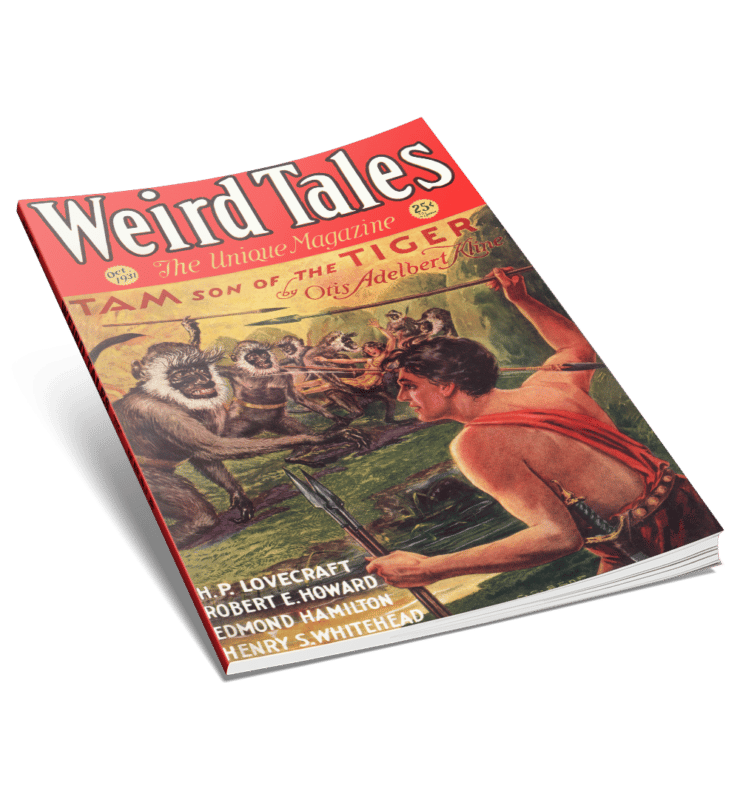
The Gods of Bal-Sagoth (first published in Weird Tales, October 1931) – Also known as The Blond Goddess of Bal-Sagoth, this is a sequel to The Dark Man despite seeing print before that story. This story can be found on Wikisource. It was adapted as a Conan story by Marvel Comics in Conan the Barbarian #17 (Aug 1972). Turlogh Dubh O’Brien or Black Turlogh, is a fictional 11th Century Irishman created by Robert E. Howard.

08
Jan
Jan
“The People of the Black Circle” is one of the original novellas about Conan the Cimmerian, by Robert E. Howard and first published in Weird Tales magazine in three parts over the September, October and November 1934 issues. Howard earned $250 for the publication of this story. This issue contains the third and last part.

08
Jan
Jan
“The People of the Black Circle” part 2 – is one of the original novellas about Conan the Cimmerian, by Robert E. Howard and first published in Weird Tales magazine in three parts over the September, October and November 1934 issues. Howard earned $250 for the publication of this story.
It’s set in the pseudo-historical Hyborian Age and concerns Conan kidnapping an exotic princess from Vendhya (prehistoric India), while foiling a nefarious plot of world conquest by the Black Seers of Yimsha. Due to its epic scope and atypical Hindustan flavor, the story is considered an undisputed classic of Conan lore and is often cited by Howard scholars as one of his best tales. It is also one of the few Howard stories where the reader is treated a deeper insight on magic and magicians beyond the stereotypical Hyborian depiction as demon conjurer-illusionist-priests.

08
Jan
Jan
“The People of the Black Circle” is one of the original novellas about Conan the Cimmerian, by Robert E. Howard and first published in Weird Tales magazine in three parts over the September, October and November 1934 issues. Howard earned $250 for the publication of this story.
It’s set in the pseudo-historical Hyborian Age and concerns Conan kidnapping an exotic princess from Vendhya (prehistoric India), while foiling a nefarious plot of world conquest by the Black Seers of Yimsha. Due to its epic scope and atypical Hindustan flavor, the story is considered an undisputed classic of Conan lore and is often cited by Howard scholars as one of his best tales. It is also one of the few Howard stories where the reader is treated a deeper insight on magic and magicians beyond the stereotypical Hyborian depiction as demon conjurer-illusionist-priests.


23
Oct
Oct
Contains non-Howard material – edited by L. Sprague de Camp
Conan the Adventurer is a 1966 collection of four fantasy short stories by American writers Robert E. Howard and L. Sprague de Camp, featuring Howard’s sword and sorcery hero Conan the Barbarian. Most of the stories originally appeared in the fantasy magazine Weird Tales in the 1930s. The book has been reprinted a number of times by various publishers and has also been translated into German, French, Japanese, Spanish, Italian, Swedish and Dutch. It was later gathered together with Conan the Wanderer and Conan the Buccaneer into the omnibus collection The Conan Chronicles 2 (1990).
Drums of Tombalku was finished by de Camp.

01
Aug
Aug
Meet John Conrad and Professor John Kirowan – Robert E. Howard’s Occult Investigators
Explore the strange and shadowed tales of John Conrad and Professor John Kirowan, two scholars who battle supernatural horrors in the 1930s. From cursed tomes to ancient evils, their stories blend arcane mystery, Lovecraftian dread, and Howard’s gripping prose.

21
Dec
Dec
The story begins with the unnamed protagonist—a Gael—venturing into a dark, labyrinthine cavern driven by his love for a yellow-haired girl, Tamera, and a dangerous curiosity about the mysterious “Children of the Night.” The Britons had told tales of these inhuman creatures, warning of their grotesque attributes and malevolent tendencies. Armed with a blade, the Gael cautiously navigates the oppressive darkness.

02
Jan
Jan
This publication was created to safeguard the copyright of Robert E. Howard’s previously unpublished works. A limited run of 12 copies was produced, with two exclusive editions bound in leather and the remainder as comb-bound paperbacks. The content includes non-Howard material in Swedish, except for Patrice Louinet’s introduction and the “Notes” section, which offers insights into the stories.