Introduction
“The Dwellers under the Tomb” is a horror story written by Robert E. Howard, likely in the early 1930s, and featuring his recurring character John Conrad. The story was submitted to Weird Tales and rejected on May 27, 1932. An alternate title, His Brother’s Shoes, is known to have been associated with the manuscript, though no additional details about that version survive.
The tale blends the Gothic with the cosmic, drawing on Howard’s interest in ancestral memory, hidden races, and ancient subterranean horrors. It stands as one of his more atmospheric pieces, combining the rational detective approach of Conrad with creeping dread and eventual confrontation with inhuman degeneration. Set in the sinister Dagoth Hills, the story leads the characters from a seemingly simple case of post-mortem hysteria into a nightmare of prehistoric tunnels and creatures lost to time—and humanity.
Detailed Summary
The story opens with John O’Donnel and his friend John Conrad being awakened at night by frantic pounding on the door. Job Kiles, a miserly and formerly composed neighbor, bursts in screaming that he has seen his twin brother Jonas—who has been dead for a week—leering in at his window. Job is convinced Jonas has returned from Hell to drag him down.
Conrad, ever the rationalist, dismisses this as madness, but agrees to accompany Job and O’Donnel to Jonas’s tomb in the Dagoth Hills to reassure him. As they traverse the windswept hills, Job raves about Jonas’s long travels in the Orient and accuses him of being a vampire who dabbled in dark magic. He reveals Jonas chose to be buried in an ancient tomb called Pirate Hill, built centuries ago by a buccaneer ancestor, Captain Jacob Kiles.
They reach the tomb. The door has not been opened, and there are no signs of recent disturbance. Still, Job insists on going in alone, armed with a flashlight and a stake. Moments later, they hear a blood-curdling scream. Job bursts out of the tomb, collapses, and dies in convulsions, his face contorted in horror. There is no wound, no physical cause of death—only the terror of something he saw.
Conrad and O’Donnel inspect the tomb. Jonas’s coffin is empty. But then they discover a secret pivoting stone in the rear wall. Behind it lies a tunnel carved into the rock. Believing Jonas to have faked his death using Eastern cataleptic techniques, Conrad speculates Jonas planned to murder his brother and assume his life and identity. They enter the tunnel and find a subterranean network of corridors and chambers.
Deeper inside, they discover a hideout where Jonas had evidently been living. It’s in disarray—furniture destroyed, supplies ripped apart, and a diary partially intact. The final entry reveals Jonas’s diabolical plan: he faked his death, preyed on his brother’s superstitions, and lured him to the tomb intending to kill him and switch places. But Jonas also wrote about something terrifying: a discovery of lower tiers of tunnels dug by an ancient race—possibly driven underground by Native Americans—that degenerated into inhuman creatures living in the blackest depths.
The last tier, Jonas discovered, ends in a smooth shaft that descends into unthinkable depths. He cleared debris blocking the way and unwittingly opened a passage to whatever now lurks below. Jonas heard strange noises but dismissed them—until he vanished.
While exploring the tunnels further, Conrad and O’Donnel hear something creeping up from below. They see yellow, slanted eyes rising from the darkness, and then a shape leaps at them. O’Donnel fires blindly. They flee back up the corridor, but hear similar sounds ahead. Realizing the labyrinth is crawling with these things, they race for the only other exit—Smuggler’s Point.
There, they find Jonas Kiles’s mutilated corpse. Whatever he awakened had claimed him, as Conrad had feared. As they escape through the door, they glimpse one of the monstrous things that killed him: a grey, shambling, dog-headed horror looming above the body.
As they flee into the night, Conrad gives voice to the dreadful truth: these were once men. The creatures that now crawl beneath the earth are the final, monstrous degeneration of a forgotten people—the dwellers under the tomb.
Characters
- John O’Donnel – The narrator of the story. A rational and skeptical observer, he accompanies Conrad and Job to the tomb and witnesses the horrors firsthand. Carries a .45 pistol and retains a Texan practicality even in moments of fear.
- John Conrad – A recurring character in Howard’s fiction. Tall, intelligent, and composed, Conrad is a man of science and philosophy, with an interest in the occult. He analyzes the unfolding events, speculates on Jonas’s cataleptic ruse, and ultimately suspects something even darker lurking beneath the tomb.
- Job Kiles – A miserly, fearful old man whose terror sets the story in motion. Haunted by his brother’s death and apparent reappearance, he insists on going to the tomb and dies from shock upon seeing what lies in the coffin. His hatred for Jonas is longstanding.
- Jonas Kiles – Job’s twin brother, a spendthrift and occultist who traveled in the Orient. He fakes his death through a cataleptic state, intending to murder his brother and assume his life. His last diary reveals his detailed and malicious plan. He ultimately falls prey to a subterranean horror in the tunnels.
- Captain Jacob Kiles – A long-dead ancestor, smuggler, and pirate who originally built the tomb at Pirate Hill. He is said to have spent much time there and may have discovered the ancient tunnels first. He does not appear in the narrative but his legacy looms over the events.
- The Dwellers – Unnamed, degenerate subterranean beings who descend from a forgotten, possibly non-Indian race driven underground centuries ago. Their physical forms are horrific—dog-headed, yellow-eyed—and they emit a reptilian stench. They are the ultimate expression of regression and horror in the tale.
Published in:
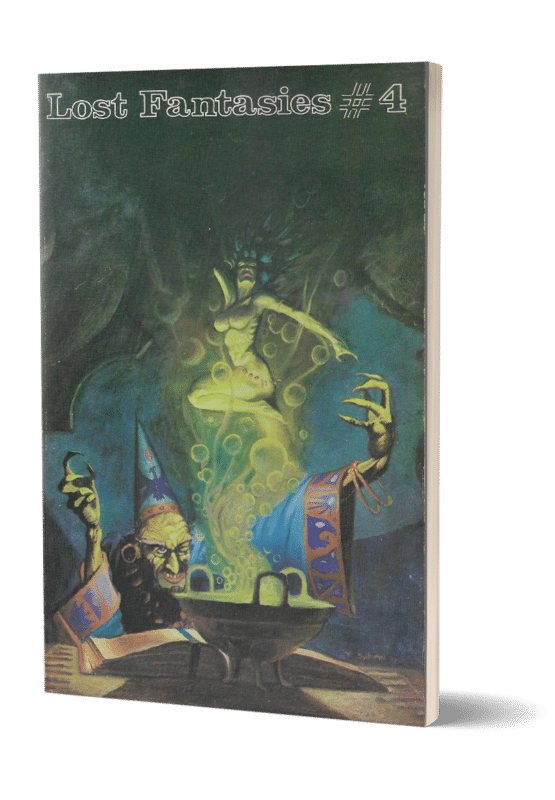
- LOST FANTASIES #4, Robert Weinberg, 1976
- SAVAGE TALES #4, Marvel, du
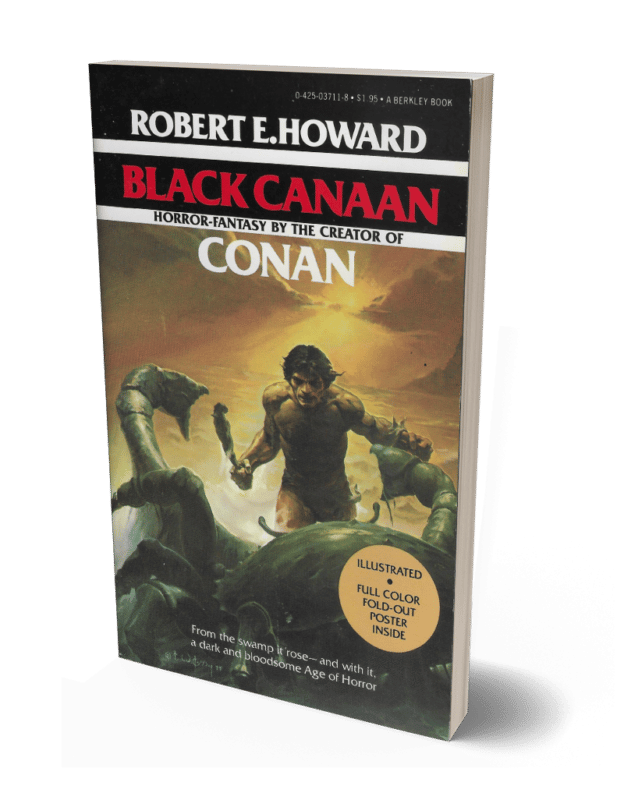
- BLACK CANAAN, Berkley, May 1978
- TERRA FANTASY 84: DAS UNGEHEUER AUS DEM SUMPF, Erich Pabel Verlag KG, 1981 (German)
- SAVAGE SWORD OF CONAN #224, Marvel, du
- LES HABITANTS DES TOMBES, NeO, September 1985 (French)
- LES HABITANTS DES TOMBES, Fleuve Noir, September 1991 (French)
- THE SAVAGE SWORD OF CONAN VOLUME 1 NUMBER 224, Marvel Comics, August 1994 (graphic adaptation)
- THE BLACK STONE, North-West, 1997 (Russian)
- THE HORROR STORIES OF ROBERT E. HOWARD, Del Rey, October 2008
- THE HORROR STORIES OF ROBERT E. HOWARD, Tantor Media, Inc., March 2010 (audio)
- THE HORROR STORIES OF ROBERT E. HOWARD, Subterranean Press, March 2011
- ナイトランド (NIGHT LAND) #4, Kuroda-han Press, Winter 2012 (Japanese)
- LES OMBRES DE CANAAN, Bragelonne, February 2013 (French)
- LES OMBRES DE CANAAN. LA PIERRE NOIRE, Bragelonne, February 2014 (French)
- DIE UNTER DEN GRÄBERN HAUSEN, Festa Verlag, August 2014 (German)
- I FIGLI DELLA NOTTE. RACCONTI DELL’ORRORE VOLUME 2, Arnoldo Mondadori Editore, December 2015 (Italian)
- O MUNDO SOMBRIO: HISTÓRIAS DOS MITOS DE CTHULHU, Editora Clock Tower, March 2016 (Portuguese)
- ČERNÝ KÁMEN, Laser Books, July 2016 (Czech)
- БЕЗЫМЯННЫЕ КУЛЬТЫ: МИФЫ КТУЛХУ И ДРУГИЕ ИСТОРИИ УЖАСА (NAMELESS CULTS: CTHULHU MYTHOS AND OTHER HORROR STORIES), AST, August 2016 (Russian)