Introduction
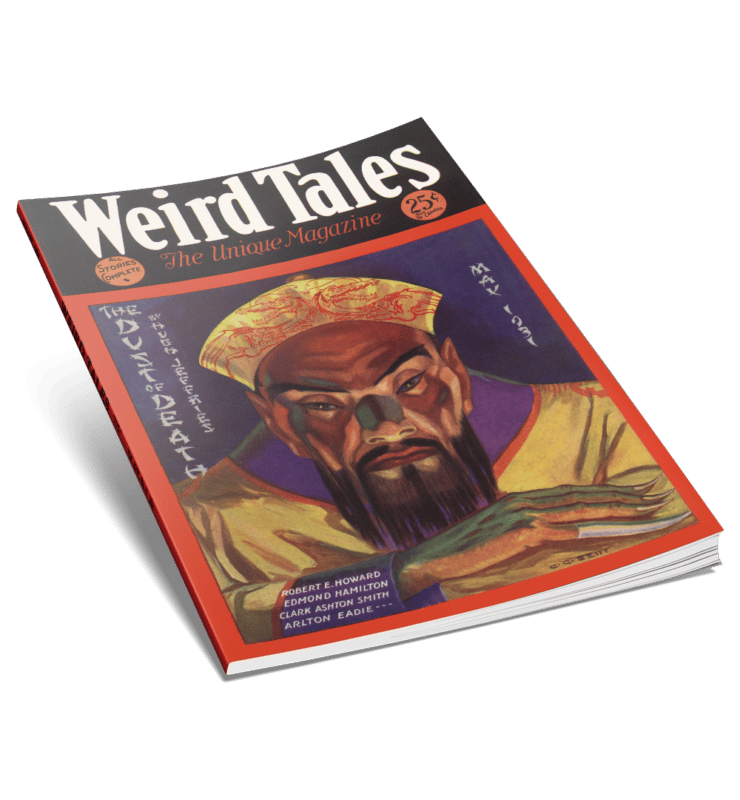
“The Children of the Night” is a 1931 short story by Robert E. Howard within the Cthulhu Mythos. Accepted by Weird Tales circa October 1930 and published in the April/May 1931 issue, it earned Howard $60. The piece reflects Lovecraft’s influence via letters—particularly remarks on witch-cults and “little people,” themes Howard also develops in “Worms of the Earth.”
The story opens in John Conrad’s artifact-crammed study, where six men—Conrad, Clemants, Professor Kirowan, Taverel, Ketrick, and the narrator John O’Donnel—debate anthropology, race prehistory, and forbidden lore (Von Junzt’s Nameless Cults, the Necronomicon). O’Donnel describes the group as Anglo-Saxon, save for Ketrick, whose slightly Mongoloid-seeming, amber, oblique eyes and faint lisp unsettle him despite Ketrick’s documented “pure” lineage—an unease that foreshadows the tale’s clash between civilized veneer and atavistic survivals.

From the letters:
In a letter to HPL (#143) Howard writes:
By the way, I recently sold Weird Tales a short story, “The Children of the Night” in which I deal with Mongoloid-aborigine legendry, touch cryptically on the Bran-cult, and hint darkly and vaguely of nameless things connected with Cthulhu, Yog-Sothoth, Tsathoggua and the Necronomicon; as well as quoting lines from Flecker’s9 “Gates of Damascus” and lending them a cryptic meaning which I’m sure would have astounded the poet remarkably!
Lovecraft liked the story and told Howard in a letter. Circa June 1931, we learn from another letter (#169) to Lovecraft:
I’m glad you liked “Children of the Night”. Some remarks of yours in your letters regarding the Mongoloid aborigines gave me many of the ideas. As regards my mention of the three foremost weird masterpieces — Poe’s, Machen’s and your own — it’s my honest opinion that these three are the outstanding tales. Though I consider your “Dunwitch Horror”, “Horror at Red Hook” and “Rats in the Walls” quite worthy of ranking alongside Poe and Machen, also.
And later (letter #220), circa mid-October 1932 we learn:
By the way, you mentioned that my “Children of the Night” got a mention in the O. Henry Memorial prize annual. What is this annual, and is it possible for me to get a copy of it? The reason I ask, is I gather it’s something of a boost to get mentioned in it, and it’s just possible that I might be able to boost myself with an editor sometime. Any information you can give me about this business will be greatly appreciated.
O. Henry Memorial Award Prize Stories of 1931, edited by Blanche Colton Williams, included “The Children of the Night” among “Stories ranking second.”
Short summary:
In Conrad’s artifact-packed study, Conrad, Professor Kirowan, Clemants, Taverel, Ketrick, and John O’Donnel argue over racial prehistory and cryptic cult survivals. Conrad displays a sinister flint mallet; Ketrick, whose oblique amber eyes unsettle O’Donnel, test-swings it and accidentally strikes O’Donnel’s head. O’Donnel’s consciousness snaps into a past life as Aryara, an Aryan warrior who awakens in a primeval forest to find his hunting band butchered by the Children of the Night—stunted, reptile-suggestive troglodytes. In a berserk counter-raid, Aryara slaughters scores before dying under their clubs and knives.
O’Donnel awakens in Conrad’s study, instantly attacking Ketrick, whom he now views as a living atavism—tainted by the ancient, reptilian strain. Restrained by the others, O’Donnel records his certainty: time sometimes “meshes,” revealing prior lives; the Children predated Picts in Britain; and Ketrick bears the old brand. He vows to hunt and kill Ketrick on the moors, even at the cost of his own life, to keep faith with his “tribe.”
Characters:
- John O’Donnel – First-person narrator. Struck by the flint mallet, he relives a past life as Aryara and returns convinced that Ketrick is an atavistic throwback he must destroy.
- Aryara – O’Donnel’s ancestral self: a bronze-age Aryan warrior who battles the troglodytic Children of the Night and dies in a last, berserk stand; invokes the smith-god Il-marinen.
- John Conrad – Erudite host and collector of occult curios; his study houses Nameless Cults, the Necronomicon (in translation), and the Neolithic mallet that triggers O’Donnel’s vision.
- Professor John Kirowan – Skeptical scholar (part of Howard’s recurring duo with Conrad). Debates race/prehistory; ultimately witnesses O’Donnel’s violent outburst.
- Clemants – Taciturn writer/editor (of The Cloven Hoof); introduces the living “Bran” cult rumor and broader hints of lingering dark survivals.
- Taverel – Witty salon participant; a foil in the bookish debates on occult literature and anthropology.
- Ketrick – Polite, aloof guest marked by amber, slightly slanted eyes and a faint lisp; after the mallet strike, O’Donnel identifies him as a reptilian atavism and vows to kill him.
- Children of the Night – Prehistoric, stunted, serpent-suggestive race dwelling in domed burrows and tunnels; speak in a hissing tongue; slaughter Aryara’s band and are massacred in his counter-attack.
- Bran Cult (allusive) – A hinted modern survival venerating the Dark Man (Bran Mak Morn); cited by Clemants via Von Junzt, linking the salon’s discourse to older, darker strata.
- Von Junzt & the Black Book – Author and tome (Nameless Cults) repeatedly referenced; emblem of forbidden knowledge threading the study talk and the tale’s Mythos texture.
Published in:
- WEIRD TALES VOLUME 17 NUMBER 3, Popular Fiction Publishing Company, April-May 1931
- THE DARK MAN AND OTHERS, Arkham House, 1963
- THE SPAWN OF CTHULHU, Ballantine, October 1971
- ミステリマガジン1971年11月( MISUTERIMAGAJIN 1971 NEN 11 GATSU) (MYSTERY MAGAZINE NOVEMBER 1971), Hayakawa Publishing Corporation , November 1971 (Japanese)
- THE DARK MAN AND OTHERS, Lancer, 1972 (n.d., 95 cents)
- L’HOMME NOIR, Libraries des Champ-Elysees, 1st Quarter 1976 (French)
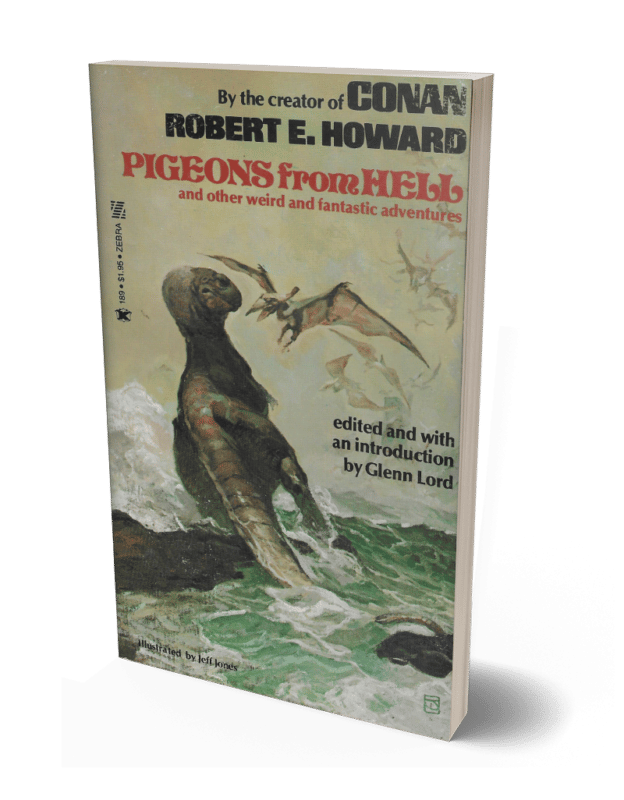
- PIGEONS FROM HELL, Zebra, June 1976
- THE DARK MAN OMNIBUS, Volume 2, Panther, 1979
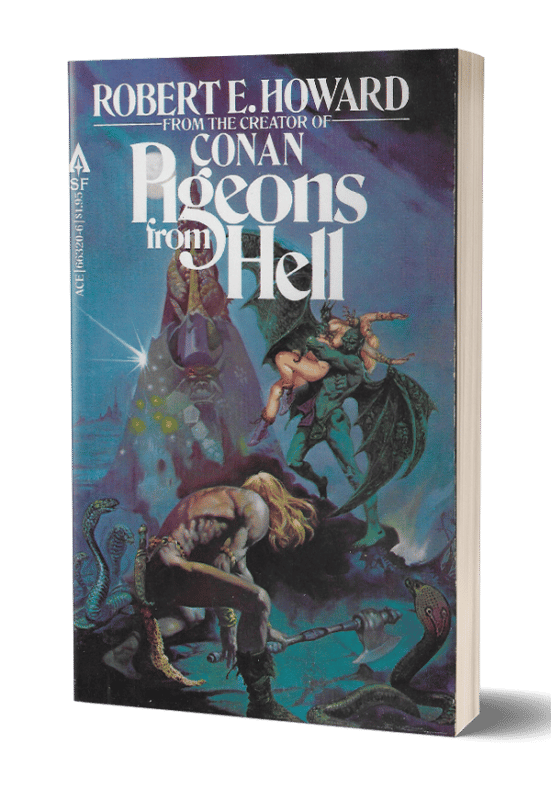
- PIGEONS FROM HELL, Ace, 1979
- L’HOMME NOIR, NeO, April 1982 (French)
- L’HOMME NOIR, NeO, February 1984 (French, 2nd printing)
- ホラー&ファンタジー傑作選3 (HORĀ ANDO FANTAJĪ KESSAKUSEN #3) (HORROR & FANTASY #3), Seishinsha, March 1986 (Japanese)
- EL VALLE DEL GUSANO, Ediciones Martinez Roca, 1986 (Spanish)
- LA MASCHERA DI CTHULHU, Fanucci Editore, July 1987 (Italian)
- L’HOMME NOIR, NeO, February 1988 (French, 3rd printing)
- ウィアード3 (WIĀDO #3) (THE WEIRD #3), Seishinsha Bunko, October 1990 (Japanese)
- L’HOMME NOIR, Fleuve Noir, December 1991 (French)
- OMBRE DAL TEMPO, Fanucci Editore, August 1994 (Italian)
- CONAN. OGNISTY WICHER, Wydawnictwo Andor, 1994 (Polish)
- NIE KOPCIE MI GROBU, Wydawnictwo Andor, 1994 (Polish)
- TUTTI I CICLI FANTASTICI: I CICLI DI KULL DI VALUSIA, DI JAMES ALLISON, DI CTHULHU E DI ALMURIC, Newton Compton Editori, April 1995 (Italian)
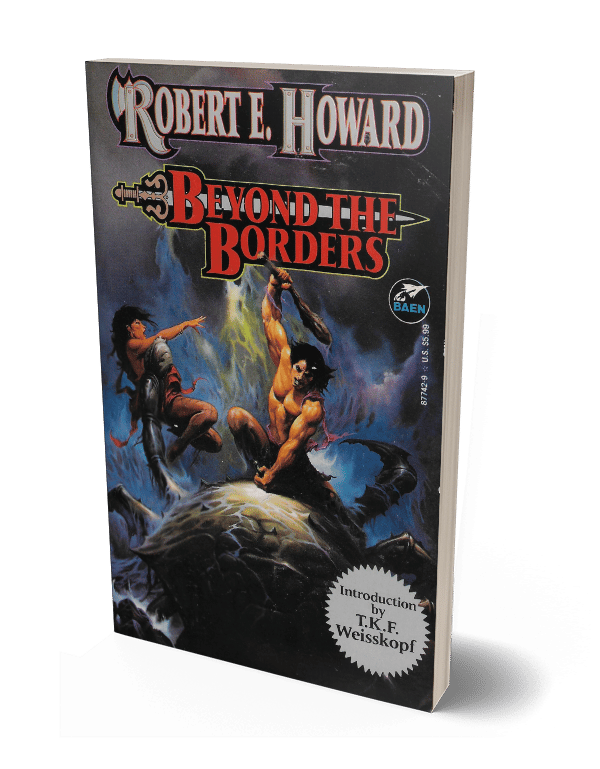
- BEYOND THE BORDERS, Baen, October 1996 (restored text)
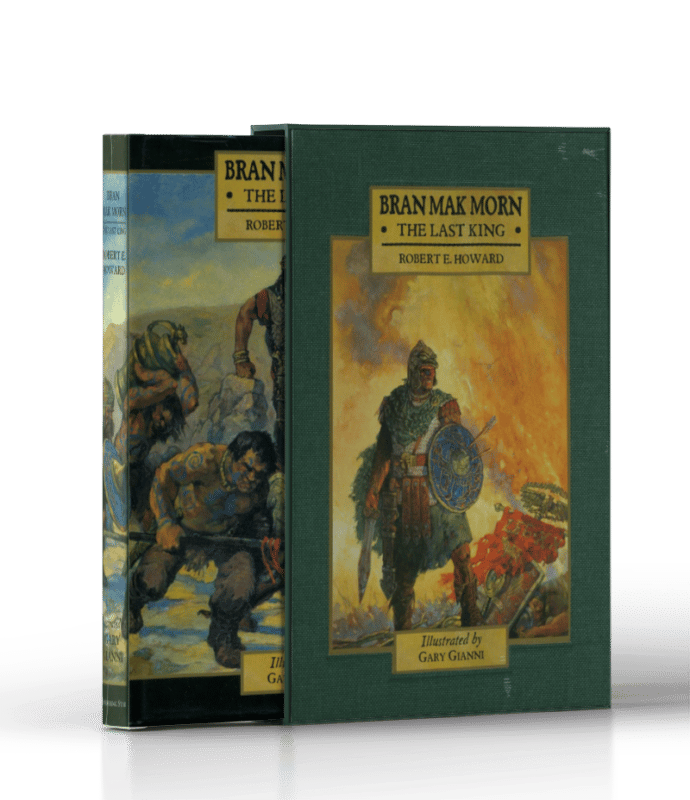
- BRAN MAK MORN: THE LAST KING, Wandering Star, 2001
- NAMELESS CULTS, Chaosium, December 2001
- BRAN MAK MORN: THE LAST KING, Del Rey, June 2005
- BRAN MAK MORN: THE LAST KING, Science Fiction Book Club, June 2005
- PEOPLE OF THE DARK, Wildside Press, July 2005
- THE WEIRD WRITINGS OF ROBERT E. HOWARD Volume 1, Girasol Collectables, January 2006
- PEOPLE OF THE DARK, Wildside Press, June 2006
- THE HAUNTER OF THE RING & OTHER TALES, Wordsworth Editions, September 2007
- THE CHILDREN OF THE NIGHT, AND BREED OF BATTLE, Dodo Press, February 2008
- RELATOS DE TERROR SOBRENATURAL, Urco Editora, April 2008 (Galician)
- THE HAUNTER OF THE RING & OTHER TALES, Wordsworth Editions, 2008
- THE HORROR STORIES OF ROBERT E. HOWARD, Del Rey, October 2008
- BRAN MAK MORN, Arnoldo Mondadori Editore, October 2009 (Italian)
- BRAN MAK MORN, L’INTÉGRALE, Bragelonne, November 2009 (French)
- THE HORROR STORIES OF ROBERT E. HOWARD, Tantor Media, Inc., March 2010 (audio)
- BRAN MAK MORN: THE LAST KING, Tantor Media, Inc., June 2010 (audio)
- THE HORROR STORIES OF ROBERT E. HOWARD, Subterranean Press, March 2011
- THE HORROR MEGAPACK: 25 CLASSIC AND MODERN HORROR STORIES, Wildside Press, March 2011
- THE HORROR MEGAPACK: 25 CLASSIC AND MODERN HORROR STORIES, Wildside Press, August 2012
- WOLFSHEAD AND OTHER STORIES, Jame-Books, August 2012
- BRAN MAK MORN ÉS A PIKTEK, Delta Vision Kft., August 2012 (Hungarian)
- BRAN MAK MORN ÉS A PIKTEK, Delta Vision Kft., November 2012 (Hungarian)
- KRÓLESTWO CIENI I INNE OPOWIADANIA Z MITOLOGII CTHULHU, Agharta, January 2013 (Polish)
- ROBERT E. HOWARD’S COLLECTED WORKS, Jame-Books, February 2013
- ROSTO DE CAVEIRA, OS FILHOS DA NOITE E OUTROS CONTOS, Martin Claret, July 2013 (Portuguese)
- LOVECRAFTIN LÄHTEILLÄ, Jalava, 2013 (Finnish)
- CULTOS INOMINÁVEIS, Saída de Emergência, February 2014 (Portuguese)
- CULTOS INOMINÁVEIS, Saída de Emergência, March 2014 (Portuguese)
- БРАН МАК МОРН, ПОСЛЕДНИЙ КОРОЛЬ. КУЛЛ, ВЫХОДЕЦ ИЗ АТЛАНТИДЫ (BRAN MAK MORN: THE LAST KING. KULL: NATIVE OF ATLANTIS), Eksmo, May 2014 (Russian)
- ROBERT E. HOWARD SHORT STORIES & NOVELLAS, Business and Leadership Publishing, July 2014
- RELATOS DE TERROR SOBRENATURAL, Urco Editora, 2014 (Galician, 2nd edition)
- I FIGLI DELLA NOTTE. RACCONTI DELL’ORRORE VOLUME 1, Arnoldo Mondadori Editore, March 2015 (Italian)
- THE SHADOW KINGDOM AND OTHER WEIRD TALES, Ulwencreutz Media, October 2015
- DIE KINDER DER NACHT, Festa Verlag, November 2015 (German)
- TALES OF CTHULHU, Perennial Press, November 2015
- O MUNDO SOMBRIO: HISTÓRIAS DOS MITOS DE CTHULHU, Editora Clock Tower, March 2016 (Portuguese)
- TALES OF BRAN MAK MORN, Ozymandias Press, June 2016
- ČERNÝ KÁMEN, Laser Books, July 2016 (Czech)
- БЕЗЫМЯННЫЕ КУЛЬТЫ: МИФЫ КТУЛХУ И ДРУГИЕ ИСТОРИИ УЖАСА (NAMELESS CULTS: CTHULHU MYTHOS AND OTHER HORROR STORIES), AST, August 2016 (Russian)
- TALES OF CTHULHU, Jovian Press, December 2016
- TALES OF BRAN MAK MORN, Jovian Press, January 2017
- I FIGLI DELLA NOTTE E ALTRI ORRORI, Golem Libri, June 2019 (Italian)
- DECA NOĆI I DRUGE PRIČE, Filip Višnjić, December 2019 (Serbian)
- GLI INFINITI RITORNI. STORIE E SCRITTI SULLA REINCARNAZIONE, Elara, July 2020 (Italian)
- THE CTHULHU STORIES OF ROBERT E. HOWARD, WordFire Press, September 2020
- LES ROIS DE LA NUIT, Le Livre de Poche, November 2020 (French)
- BRAN MAK MORN. O ÚLTIMO REI DOS PICTOS, Pipoca e Nanquim, March 2021 (Portuguese)
- STRANGE STORIES OF ROBERT E. HOWARD & CO., Robert Derie, June 2021
- I RACCONTI RITROVATI, Independently Published, December 2021 (Italian)